There is a strange thing that happens in business.
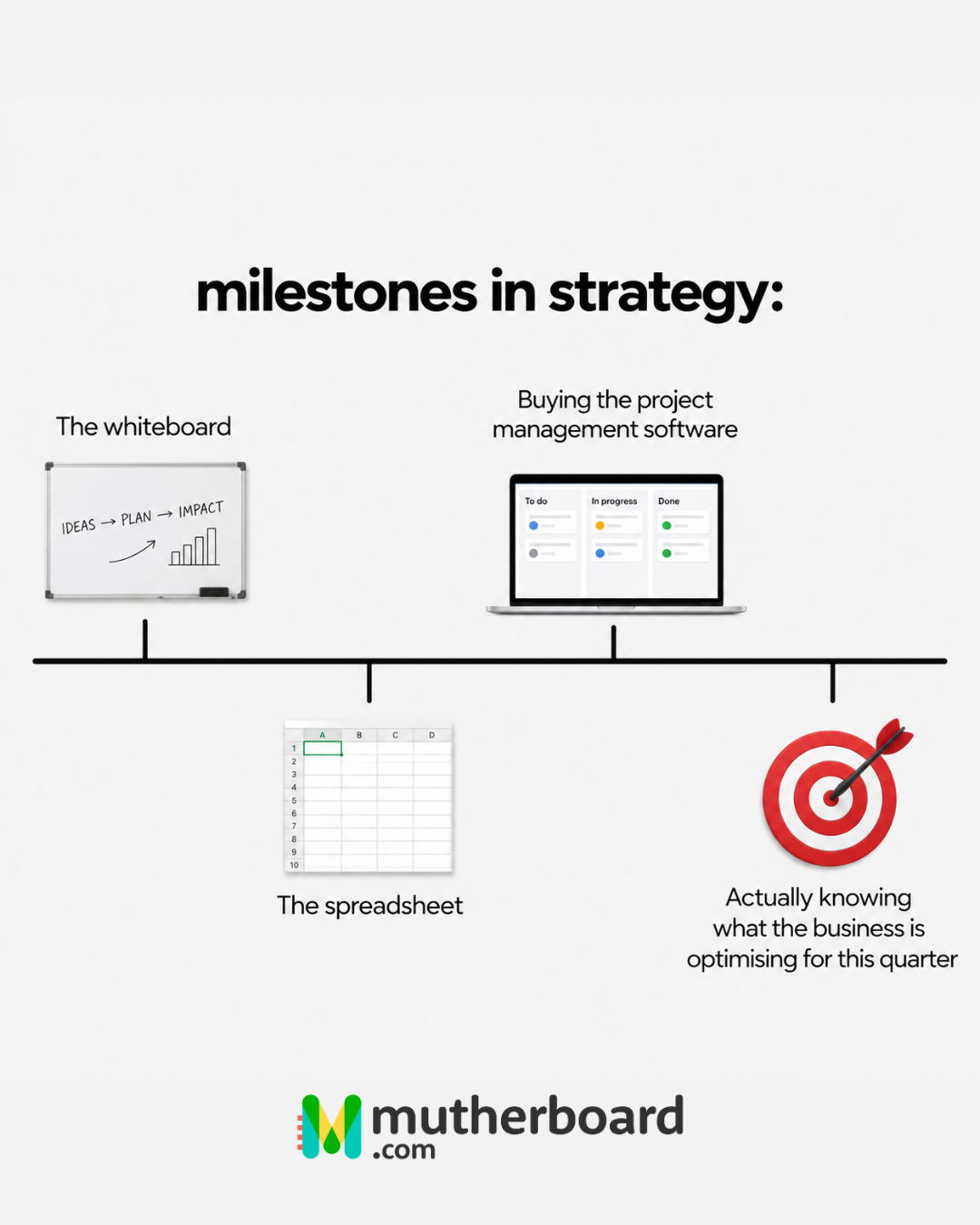
You start with a whiteboard full of ideas. Then someone builds a spreadsheet. Then the spreadsheet gets too complicated, so you invest in project management software. Then you add dashboards, reporting tools, integrations, automation and, naturally, a little AI because everyone else seems to be doing it.
Suddenly, you have an impressive technology stack.
But ask one simple question:
“What are we actually trying to achieve this quarter?”
And things get a little quieter.
Because your tools are not your strategy.
They are supposed to support your strategy. But the way your business uses them can reveal a lot about whether that strategy is actually clear.
Your tools are a reflection of your business
A project management platform cannot tell you what your priorities should be.
A spreadsheet cannot decide which projects will have the biggest impact.
An AI tool cannot fix a process that nobody understands.
And an integration cannot create alignment between teams that are not working towards the same goals.
The technology can make things easier, faster and more visible, but only when there is something meaningful for it to support.
When there is not, businesses often end up adding more tools in the hope that the next one will solve the problem.
New tool. New dashboard. New workflow. Same confusion.
The issue is not always the technology. Sometimes the technology is simply making an existing strategic problem much easier to see.
What your tools might be telling you
Take a look at how your teams actually work.
If your project management system is full of tasks but nobody can clearly explain how those projects contribute to your business objectives, you may have a prioritisation problem.
If your resource planning happens in a spreadsheet that only one person truly understands, you may have a visibility problem.
If your teams are constantly copying information from one system into another, you may have an integration problem.
If you are introducing AI into workflows that are already unclear or inefficient, you may be creating an automation problem rather than solving one.
And if every department has its own version of what is important, you may have an alignment problem.
Your tools are not necessarily causing these issues.
They are revealing them.
Strategy should come first
A good strategy gives your business something to work towards.
Your systems should then help your people understand what needs to happen, who needs to do it, what resources are available and whether you are actually making progress.
That means asking questions such as:
What matters most right now?
Which projects support those priorities?
Do we have the right people and resources available?
Can our systems share the information they need to?
Where can AI genuinely improve the way we work?
Can leadership see what is happening without asking five different people for five different reports?
When those answers are clear, technology becomes incredibly powerful.
You can automate the repetitive stuff.
Connect the systems that need to talk to each other.
Improve project visibility.
Make better use of your resources.
Use AI where it genuinely adds value.
And give your teams a much clearer view of what they are working towards.
Stop collecting tools. Start connecting them to the bigger picture.
The goal should not be to have the most impressive tech stack.
It should be to have a business where your technology, people and processes are all pulling in the same direction.
Because the real milestone is not:
“We bought project management software.”
It is:
“We know why we are using it, what it needs to help us achieve and how we will know if it is working.”
Your tools are not the strategy.
But if you look closely, they might tell you a lot about whether your strategy is actually working.